If your white Tesla interior has gone grey-blue along the bolsters and the seat edges, you are almost certainly looking at indigo dye transfer from denim, not at dirt. That matters because it changes the fix completely: dirt sits on the surface and wipes off, whereas dye migrates into the surface and has to be drawn back out.
The mechanism is well understood. The indigo used in most denim is not fully fixed to the fibre, and it moves under friction, pressure and heat. Sliding across a bolster in dark jeans on a warm day is precisely those three conditions at once, which is why the marks follow the contact pattern rather than appearing randomly.
What actually marks a white interior
| Cause | Where it shows | How hard to remove |
|---|---|---|
| Denim dye transfer | Driver's bolster, seat edges, outer cushion | Moderate — it has migrated into the surface |
| Dark fabric left in contact | Anywhere a bag, coat or cover sat under pressure | Moderate — same mechanism, sharper edges |
| Shoe scuffs | Lower side panels, seat backs, door sills | Easy if caught early, permanent if ground in |
| Food and drink | Cushion, console surround | Easy, if you get to it the same day |
| Sunscreen and hand cream | Steering wheel, armrest, door pull | Hard — oils carry pigment and spread it |
| General soiling | High-contact surfaces generally | Easy |
How to get dye transfer out
Step 1. Act early
Fresh transfer comes out far more easily than transfer that has sat through a few hot days. Heat drives dye deeper, so a mark discovered in July is a worse job than the same mark in November.
Step 2. Start with the gentlest thing that works
A damp microfibre cloth with a dedicated interior cleaner formulated for synthetic leather. Work a small area, lift rather than scrub, and change cloth faces constantly so you are not moving dye around.
Step 3. Never go straight to a solvent
Alcohol, acetone and magic-eraser-type abrasives can take the surface finish off vegan leather along with the stain, and that damage is not reversible. The finish is what stops the next stain.
Step 4. Repeat gently rather than escalating
Three gentle passes with drying time between them beat one aggressive pass. Dye removal is a lifting process, not a scrubbing one.
Step 5. Condition afterwards
A cleaned panel has lost some of its surface protection. A product intended for synthetic upholstery restores it, and a protected surface resists the next transfer far better.
Prevention, which is the part this site can actually help with
Removal is a cleaning problem and you will be doing it either way. Where accessories genuinely change the outcome is on the surfaces that take repeated contact and cannot be wiped easily — the seat backs, the lower side panels and the sills. Those are the places where a white interior ages visibly fastest and where a fitted protector does more than any product in a bottle.
- Seat backs. The largest vertical white surface in the car and the one that takes shoes, bags and knees. Covered properly, it stops being a maintenance item.
- Lower side panels. The band below the seat back that most protectors miss entirely, and the one that collects scuffs from feet and luggage.
- Door sills. Every entry and exit drags across them; sill protection is a cheap and permanent fix.
- Footwells. Dirt reaching white carpet is the hardest of all of these to reverse, which is the real argument for all-weather mats in a white-interior car.
- The driver's bolster. The one place no accessory helps, which is why the denim advice above matters.
Quick picks
| # | Product | Best for | Score | Price |
|---|---|---|---|---|
| 1 |  BASENOR 3-piece rear seat-back cover The maximum-coverage choice, and the right one if children ride in the back. | Best preventive coverage | 8.9 | |
| 2 |  BASENOR anti-kick side mats The finishing piece. Buy it with the seat backs, not on its own. | Best for the panels nobody covers | 8.4 | |
| 3 | 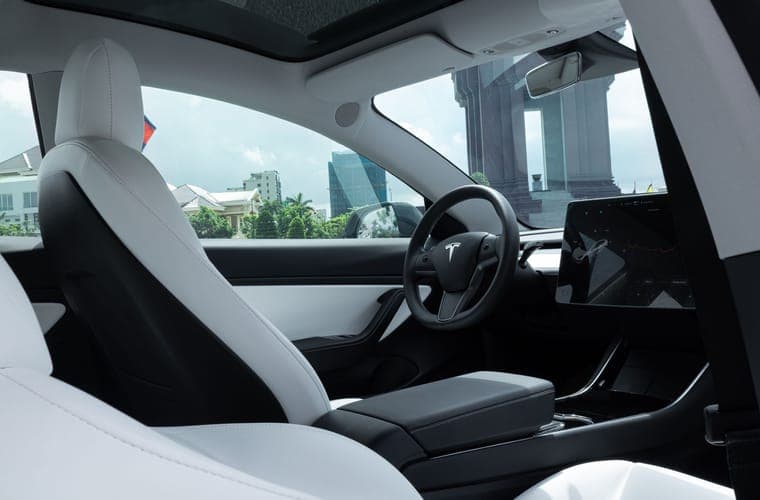 BASENOR leather seat-back kick protector The surgical option. Cheaper than full coverage and solves the common case. | Best at the height it matters | 8.7 |
Scores are our editorial assessment of fitment scope, published materials and coverage. They are not lab measurements and we have not tested these products.
1. Best preventive coverage
BASENOR 3-piece rear seat-back cover
The largest protected surface area available for the second row, which is where dye transfer and scuffing concentrate on a family car. It protects the seat backs and the panels behind them; it does nothing for the cushion you are sitting on.
Best for: Families — the largest protected surface area available
Fits: Model Y (2020-2024) · Model Y Juniper (2025-2026) · Model 3 (2017-2023) · Model 3 Highland (2024-2026)
What works
- Covers the whole seat back rather than just the kick zone, which is what you want with toddlers
- Three pieces means the center section is covered too, not just the two outer seats
What does not
- Full coverage changes how the cabin looks from the back seat
- More material to remove and clean than a small kick mat
Manufacturer specifications
- Three pieces covering the full rear face of the front seats
- Listed across Model Y, Model 3 and the Juniper
- Wipe-clean surface
Specifications as published by the manufacturer. We have not independently tested this product.
Specification sources: BASENOR seat-back protector and kick-mat comparison, BASENOR Tesla seat-cover collection
2. Best for the panels nobody covers
BASENOR anti-kick side mats
The lower side panels that seat-back covers miss, and a genuine white-trim trouble spot because shoes and bags hit them repeatedly. Juniper only.
Best for: The lower side panels that seat-back covers miss
Fits: Model Y Juniper (2025-2026)
What works
- Covers the area that still gets filthy after you have protected the seat backs
- Cheap addition to a seat-back set rather than a standalone purchase
What does not
- Only worth buying alongside seat-back protection, not instead of it
- Juniper-specific, so legacy owners have fewer options
Manufacturer specifications
- Panels for the lower side trim beside the rear footwells
- Listed for the Juniper
- Wipe-clean surface
Specifications as published by the manufacturer. We have not independently tested this product.
Specification sources: BASENOR seat-back protector and kick-mat comparison
3. Best at the height it matters
BASENOR leather seat-back kick protector
Covers the exact band where children's shoes land, which is also where dark denim rubs when adults climb in. Listed across both cars and all four generations. A single band, not whole-seat coverage.
Best for: The exact height children's shoes hit
Fits: Model Y (2020-2024) · Model Y Juniper (2025-2026) · Model 3 (2017-2023) · Model 3 Highland (2024-2026)
What works
- Targets the scuff zone precisely instead of covering the whole seat
- The pocket is genuinely useful for a tablet or a water bottle
- Leather-look finish sits better with the factory interior than a nylon mat
What does not
- Leaves the upper seat back exposed, which matters if your child is tall enough to reach it
- Microfibre leather marks if you clean it with the wrong product
Manufacturer specifications
- Microfibre leather panel targeting the lower seat back
- Integrated storage pocket
- Listed for Model Y, Model 3, Model S and Model X
Specifications as published by the manufacturer. We have not independently tested this product.
Specification sources: BASENOR seat-back kick protector listing, BASENOR seat-back protector and kick-mat comparison
The thing we cannot fix for you
There is no product that stops dye transferring to the seat cushion you sit on, because anything that would cover it would also be the thing you sit on. Owners who keep white interiors looking new over years tend to do one unglamorous thing consistently: they clean the bolsters often, before anything has set, rather than waiting for a mark to be worth addressing.
If you are considering a full seat cover to solve this, read Tesla seat covers vs seat protectors first. Covers do prevent transfer, and they come with trade-offs — heaters, airbag seams and the fact that you have hidden the interior you paid extra for — that are worth understanding before you order.
For the second row specifically, seat-back covers vs kick mats decides between full coverage and a targeted band, and the kick-protector roundup lists the options per generation.
Questions people actually ask
Why do Tesla white seats turn blue or grey?
Indigo dye from denim. The dye is not fully fixed to the fibre and migrates into the seat surface under friction, pressure and heat, which is why marks follow the contact pattern of where you sit and slide.
Does Tesla white interior stain easily?
It resists ordinary soiling well, because it is a sealed synthetic surface rather than a porous one. Dye transfer is the exception, and it is the complaint almost every owner report comes down to.
How do you remove jean dye from a Tesla seat?
A dedicated interior cleaner for synthetic leather, applied with a damp microfibre cloth in repeated gentle passes, then condition the panel afterwards. Avoid alcohol, acetone and abrasive erasers — they take the finish off with the stain.
What stops it happening in the first place?
On the cushion you sit on, only cleaning early and often. On seat backs, lower side panels, sills and footwells, fitted protection works and is the better use of money.
Sources
- BASENOR — how to clean Tesla white seats and remove jean stains
- BASENOR seat-back protector and kick-mat reference
- BASENOR leather seat-back protector listing
- Tesla Owner's Manual (North America PDF)
Specifications and fitment claims on this page come from the manufacturer and retailer pages listed above. We have not tested these products and do not claim to have.
Read next
Guides
Tesla Model Y Seat Covers vs Seat Protectors
Full covers against targeted protection: what each one solves, the heater and airbag caveats, and the purchase most owners actually want.
Interior Protection
Seat Back Covers vs Kick Mats
One measurement decides it: how high your child's feet reach. Coverage, cost and the honest case for each.
Interior Protection
Best Seat Back Protectors for the Model Y
Seat-back covers and kick mats for the Model Y, with the coverage decision driven by how tall your children are.
Interior Protection
Best Door Sill Protectors for the Model Y
Door sill, trunk sill and bumper protectors for the Model Y, with the adhesive trade-off stated.
Guides
How to Clean Tesla Floor Mats
Step-by-step cleaning for all-weather liners and carpeted mats, and the drying mistake that warps a liner.
Guides
Tesla With Kids: The Accessories That Actually Matter
A priority-ordered checklist for carrying children in a Model Y or Model 3, with the car-seat question answered.